Overview
"Head gasket" are the two words nobody wants to hear, and half the time they are said on guesswork: white smoke, a milky cap, an overheat - must be the gasket. Sometimes it is. Often it is not. And because the repair means taking the top off the engine, guessing wrong in either direction is expensive: condemning a healthy engine writes off a good car, while driving on with a genuinely failed gasket cooks the engine for good.
The combustion leak test - the block test - removes the guesswork for the price of a takeaway. A chambered tester sits in the coolant tank neck and draws the air above the coolant through a blue indicator fluid. If combustion gases are getting into the cooling system, the fluid changes colour. If they are not, it stays blue. That is the whole test: chemical, binary and definitive. This guide shows it on two real cars from the workshop - a Ford Transit that failed emphatically, and an overheating Honda Civic that got its verdict in sixty seconds through the radiator neck.
Signs That Point at a Head Gasket
- Coolant level dropping with no visible external leak
- Thick white, sweet-smelling smoke from the exhaust
- Engine running rough, especially from cold
- Bubbles rising in the expansion tank with the engine running
- Milky mayonnaise on the oil cap or dipstick
- Repeated overheating, or heat soon after setting off
- Black exhaust staining inside the coolant bottle
What You Need

The UK Car Owner's Essential Guide
- Every dashboard warning light explained
- Fluid, tyre and service checks you can do yourself
- How to avoid getting stung at a garage
Instant PDF download · works on phone, tablet or PC · 7-day money-back guarantee
Step-by-Step Guide
Read the warning signs first
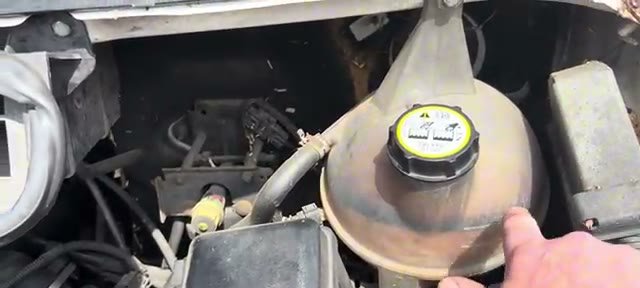
The Ford Transit in this guide arrived with the classic trio: losing coolant fast, running rough, and white smoke from the exhaust. Before any kit came out, one look inside the coolant bottle added the fourth clue - a black staining line around the inside, left by exhaust gases forcing their way through the cooling system. Any one sign can have another cause; together they point firmly at the head gasket.
Check the dipstick and oil filler cap
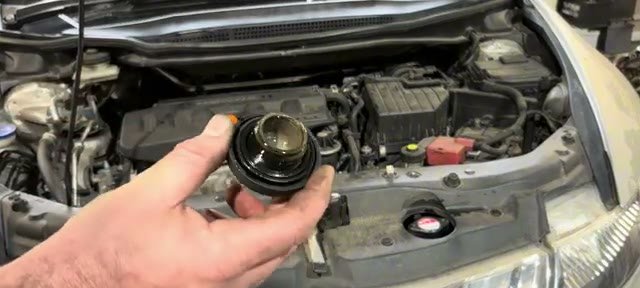
Two free checks before the tester: pull the dipstick and look for milky, coffee-coloured oil, and take off the oil filler cap and check its underside. The Honda Civic in this guide showed a slightly milky cap - but do not condemn an engine on that alone. Short-journey cars build harmless condensation in the head that leaves the same mayonnaise on the cap. It is a clue, not a verdict.
Set up the block tester
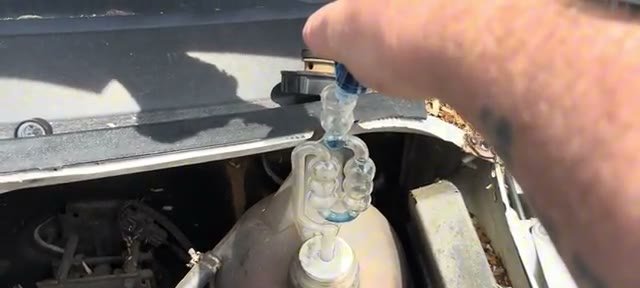
The tool for the definitive answer is a combustion leak tester - a glass-chambered device that costs less than a tank of fuel. Fill its chambers with the blue test fluid to the marked level, then seat the rubber bung into the neck of the coolant expansion tank in place of the cap. If the tank is brimmed, let a little coolant out first: the tester must sample the AIR above the coolant, never the liquid itself.
Start the engine and let it warm up
Start the engine and let it idle. The fluid starts pure blue - that is your baseline, and it needs to stay visible while the engine comes up to temperature over 5 to 10 minutes. Heat matters: a hairline crack or a marginal gasket failure opens up as the metal expands, so a stone-cold test can pass an engine that fails twenty minutes later.
Pull the gases through the tester
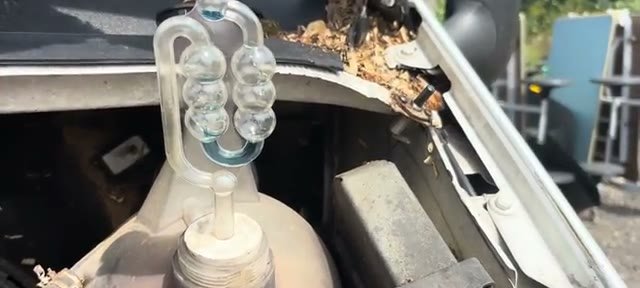
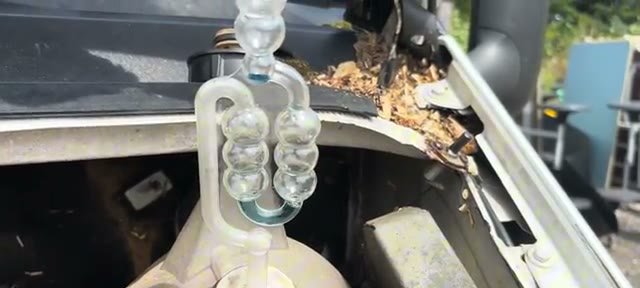
The air from the tank has to bubble up through the test fluid to be sampled. It happens on its own as the coolant heats and expands, but you can speed the process up the way we do in the workshop: squeeze the top radiator hose rhythmically, and each squeeze pushes another gulp of air from the system up through the chambers.
Watch for the colour change
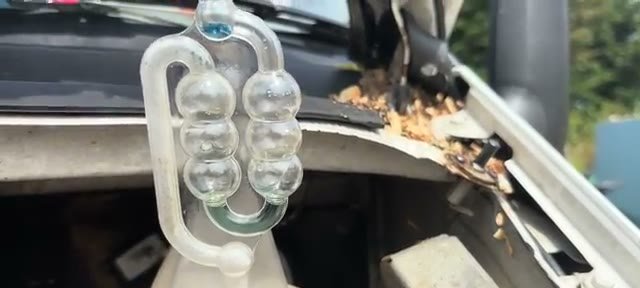
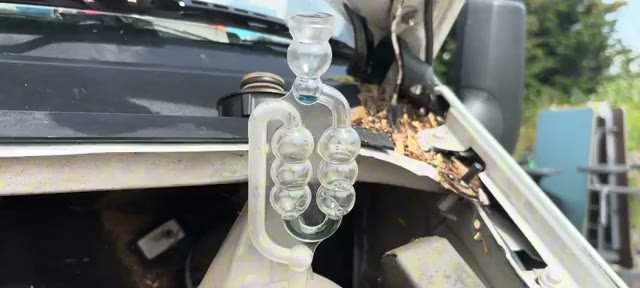
Now watch the chambers, comparing against the reserve of unused fluid at the top. On the Transit the change started within a couple of minutes: the fluid in the trap turning from blue towards green while the reservoir above stayed original blue. That side-by-side comparison is your reference - if the working fluid is drifting green or yellow, it is reacting with carbon dioxide from combustion.
Call the verdict
Left running, the Transit's fluid went a clear greeny-yellow - a definitive fail. The chemistry only reacts to exhaust gases, so a colour change means combustion is reaching the coolant: a failed head gasket, or less commonly a cracked head or block. Even after shutting the engine off, pumping the trapped gases through still showed the change. A fluid that stays blue after a full warm-up and plenty of bubbles is an honest pass.
The 60-second version on an open radiator
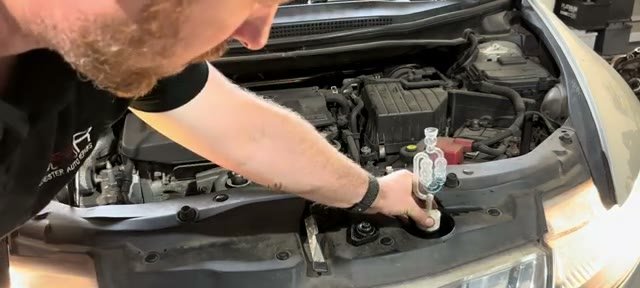
On the overheating Honda Civic the radiator cap was accessible directly, so the test got even simpler: engine running, hold the charged tester over the open radiator neck and let it sniff the rising air. The fluid changed colour within a minute - exhaust gases confirmed, head gasket gone. Same chemistry, same verdict, one minute of work.
What the Test Actually Detects
Combustion happens at well over 100 bar; the cooling system runs at barely 1.5. Any breach between the two - a burnt gasket fire ring, a warped head face, a crack - lets combustion gas hammer its way into the coolant on every firing stroke. The block tester's fluid is a CO2 indicator: plain air leaves it blue, combustion gas turns it green, heavy contamination drives it to yellow. That is why the result is so much more trustworthy than symptom-reading - the fluid does not care how the car sounds or what the last garage said. It only reacts to combustion gas where combustion gas should never be.
One honest limitation: the test tells you combustion gas IS reaching the coolant, not precisely which joint it crossed. In practice the head gasket is the culprit far more often than a cracked head or block - but the difference matters for the repair bill, so the head always gets checked and measured once it is off.
If the Test Fails - Making the Repair Decision
A green result is a stop-driving result: every heat cycle from here pushes more gas into the coolant, more heat into the head, and more money onto the bill. The repair itself is all labour - the head comes off, gets pressure-checked and usually skimmed flat, then rebuilds with a new gasket and stretch bolts. On an easy four-cylinder that can be several hundred pounds; on a harder layout it sails past a thousand. Whether that is worth it depends entirely on the car underneath: run the numbers through our keep or sell calculator before committing either way, and see the repair cost guides for what fair UK pricing looks like on big jobs generally.
And if the test PASSES but coolant keeps vanishing: the loss is external or a different internal route. Put the system under pressure with our coolant leak pressure test guide - the two tests together corner every possible escape route, and on many diesels a failing EGR cooler deserves suspicion before any head comes off.
What It Costs
| Route | Typical price | What you get |
|---|---|---|
| Block tester kit + fluid | £10–£25 | Reusable tester; fluid does many tests and refills are cheap |
| Garage combustion test | £40–£80 | Same chemistry with experienced eyes on the result |
| Head gasket repair | £500–£1,500+ | Gasket set, skim, bolts and a lot of labour - engine dependent |
Typical UK prices in 2026. The £15 test is the cheapest decision-maker in motoring: it either saves a £1,000 repair on a healthy engine or stops you pouring coolant into a doomed one.
Common Mistakes with the Block Test
- Testing stone cold and believing the pass. Cracks and marginal gaskets seal until the metal expands. Full temperature, ten minutes of bubbles, then believe it.
- Letting coolant reach the fluid. The tester samples the air above the coolant. Liquid in the chambers dilutes the indicator and wrecks the result - drop the tank level a touch first.
- Condemning an engine on a milky cap alone. Short-journey condensation makes identical mayonnaise. The block test is the referee, not the cap.
- Ignoring a fail because the car "drives fine". It does - right up until the overheat that warps the head. A green result driven on is an engine bill in the post.
- Skipping the retest after the repair. Five minutes with the tester after the rebuild proves the head is sealed and the skim was true. Do it before the car goes back to work.
- Forgetting the test at used-car viewings. Fifteen minutes on the seller's driveway settles the one fault that is easiest to hide and dearest to inherit.
Stay Ahead of It
Most head gaskets do not fail on their own - they are killed by overheating, and overheating is nearly always the end of a story that started with a small coolant leak or old coolant eating the system from inside. Find losses early with the pressure test guide, keep the coolant changed on schedule (your reg into the maintenance schedule checker shows what is due), and treat any temperature gauge wandering as an appointment, not a suggestion. If the symptoms are still ambiguous, the symptom finder will rank the likely causes before you spend anything.
Verdict
The block test is as close as DIY diagnosis gets to a straight answer: blue means sealed, green means failed, and the kit costs less than an hour of any garage's time. The Transit in this guide proved a suspicion in ten minutes; the Civic got its answer in one. Test warm, keep the fluid clean of coolant, read the colour against the reserve at the top, and let the chemistry - not the folklore - decide what happens to the engine next.