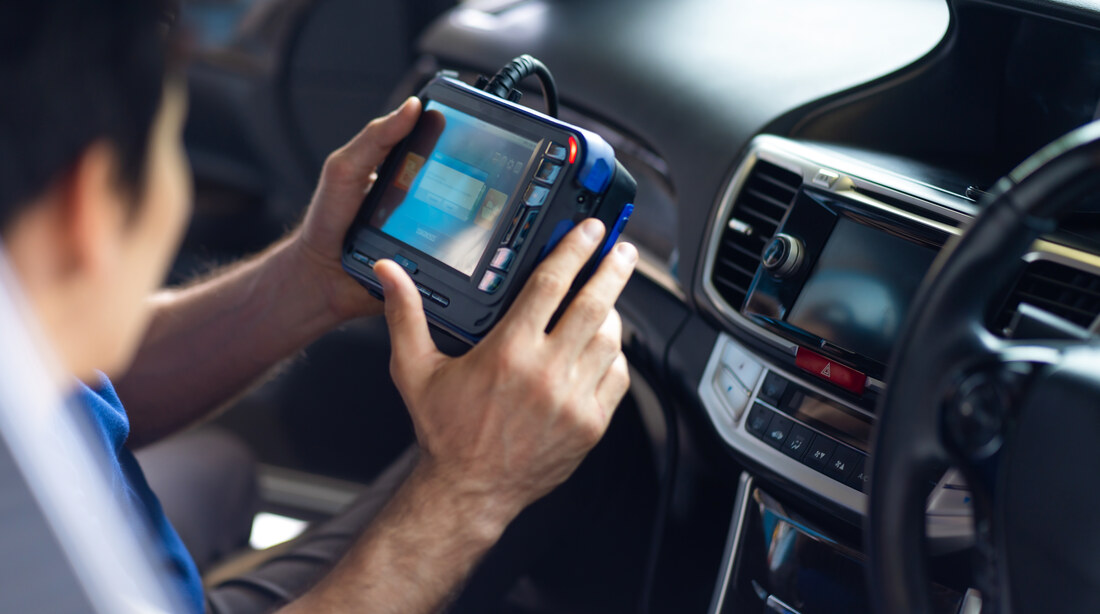
A diagnostic check at your local garage will cost you somewhere between £60 and £120, and half the time all they do is plug in the same generic scanner you could own yourself for under £40. Here's how to read your own OBD2 codes properly, which scanner is worth buying, and - just as importantly - where DIY scanning runs out of road.
I get cars in the workshop every week where the owner has spent £80 on a "diagnostic" only to be told there's a P0420 logged, hand over £40, and go home no wiser. That's not diagnostics. That's reading a number off a screen. With the right kit and ten minutes of patience, you can do exactly the same thing on your own driveway, and then start making actual sense of what the car is telling you.
What OBD2 Actually Is
OBD stands for On-Board Diagnostics. The second-generation standard - OBD2 - has been mandatory on every petrol car sold in the UK since 2001, and every diesel since 2004. That means any car newer than that, whether it's a Vauxhall Corsa or a Range Rover, has a standardised 16-pin trapezoidal socket somewhere inside the cabin that any generic scanner can talk to.
On most UK cars the port lives under the steering column, tucked up above the pedals or behind a small flap on the lower dash. On some BMWs and Land Rovers it's in the centre console or glovebox. If you cannot see it, grab a torch and look upwards from the driver's footwell. It will be there. The socket itself is keyed so you can only plug a scanner in one way round.
The Four Code Prefixes - P, B, C and U
Every code starts with a letter. The letter tells you which family of systems the fault belongs to:
- P (Powertrain) - engine, fuel system, ignition, transmission, emissions. This is the big one. 90% of fault codes you'll ever see start with P.
- B (Body) - airbags, seatbelt pretensioners, central locking, climate control, lighting.
- C (Chassis) - ABS, traction control, stability control, electric power steering, suspension.
- U (Network) - communication between control modules over the CAN bus. A U-code usually means one module has stopped talking to another.
A cheap generic scanner will read P-codes flawlessly. Most will read B, C and U codes on modern cars too, but the depth varies - and that's where mid-range tools start to earn their keep.
The Five-Character Code, Decoded
Take P0301 as an example. Every character has a meaning:
- P - Powertrain
- 0 - Generic SAE code (1 would mean manufacturer-specific)
- 3 - Ignition system / misfire
- 01 - Cylinder 1
So P0301 reads as: "generic powertrain fault, ignition system, cylinder 1 misfire". You can decode any code this way once you know the structure. The second digit is the subsystem family: 1 and 2 are fuel and air metering, 3 is ignition, 4 is emissions, 5 is vehicle speed and idle, 6 is the computer itself, 7 to 9 are transmission.
Generic vs Manufacturer Codes
The second character is the one that catches people out. P0xxx codes are generic - defined by the SAE standard and the same across every brand. P1xxx codes are manufacturer-specific, and the meaning is set by Ford, BMW, VW or whoever built the car. A P1336 on a Mercedes means nothing to a Vauxhall scanner. This is why a £30 dongle will sometimes show you a P1xxx code with no description - it has read the number but does not have the manufacturer's lookup table.
Quick Rule
If the code starts with P0 you can look it up online and the meaning will be correct. If it starts with P1, B1, C1 or U1, you need either a brand-specific scanner or a manufacturer-specific decode list.
Budget Scanners Worth Buying (£25–£90)
For 90% of UK drivers, a budget scanner is all you'll ever need. These four are the ones I see most often and would happily recommend:
| Scanner | Typical Price | Best For |
|---|---|---|
| Topdon AL300 / AL400 | £35–£55 | Reads/clears P-codes, freeze frame, I/M readiness, basic live data |
| Autel ML319 | £30–£40 | Solid build, fast reading, good for occasional use |
| FOXWELL NT301 | £45–£65 | Slightly better live data, well-respected on enthusiast forums |
| Launch CRP123E | £70–£90 | Steps up to engine, ABS, SRS and transmission codes |
If you only own one tool, an Autel ML319 or Topdon AL300 will get you out of trouble on almost any engine fault.
Mid-Range Scanners (£100–£250)
The next tier opens up modules beyond the engine. You can read ABS pump codes, airbag (SRS) codes, transmission codes and sometimes basic body codes. Two I rate on a working budget:
- Autel ML629 - about £140. Engine, ABS, SRS and transmission. Good for diagnosing wonky ABS lights and getting service messages off the dash.
- Launch CRP129E Pro - about £190. Same coverage plus EPB (electronic handbrake) reset, oil service reset, throttle adaptation. The one I'd recommend if you do your own brake jobs on a modern car.
When You Need a Manufacturer Tool
There is a hard ceiling to what generic scanners can do. If you're trying to code a new key to a BMW, reset an adaptation map on a VW DSG box, recalibrate a steering angle sensor on a Ford, or read a comfort module on a Mercedes - the £30 ELM327 dongle is not going to cut it. You need the manufacturer's own software:
- BMW ISTA - full dealer-level coding and diagnostics.
- VW VCDS (Ross-Tech) - the gold standard for VW, Audi, SEAT, Škoda.
- Ford FORScan - surprisingly cheap, very powerful for Ford, Mazda and Lincoln.
- Mercedes XENTRY - used by main dealers and serious indies.
For most home users this is overkill. But it's why dropping the car at a specialist costs more than dropping it at Halfords - the specialist owns the proper software.
Phone Dongles vs Handheld Scanners
The £15–£30 Bluetooth dongles paired with apps like Torque Pro, Car Scanner or OBD Fusion are genuinely useful. I have one in my van toolbox for quick checks. The pros are obvious: cheap, no battery to flatten, big phone screen, easy to email screenshots. The cons are equally real: cheap dongles are slow, drop the connection, often won't read enhanced modules, and can drain the car battery if you leave one plugged in for days.
A handheld scanner boots in two seconds, works without a phone, and won't disconnect halfway through reading. For occasional checks, a dongle is fine. For actual fault chasing, a handheld is faster and less frustrating.
The Clearing-Codes Trap
This is the bit that people get badly wrong. Clearing a code does not fix the fault. If you've got a P0420 (catalyst efficiency below threshold) and you clear it, you have not repaired the catalytic converter. You've reset the monitor. The ECU will go back and re-run its catalyst test over the next few drive cycles, find the same problem, and log the same code. The light comes back.
Buying Used? Watch This
If you scan a car that's about to be sold and there are zero codes but the readiness monitors show "not ready", somebody has cleared the memory recently. On a car that's been driven properly all the monitors should read "ready". A recently-cleared car with no codes is one of the biggest red flags in used buying.
How to Actually Read Codes - Step by Step
- Find the OBD2 port (under steering column on most UK cars). Key off.
- Plug the scanner in. The connector only fits one way.
- Turn the key to position II (ignition on, engine off). Dash lights up but the engine doesn't crank.
- Wait for the scanner to boot and shake hands with the ECU.
- Select "Read Codes" or "Trouble Codes". Note both stored and pending codes. Pending means the fault has been seen once but not yet confirmed - useful early warning.
- Look at Freeze Frame data for each code. This is the snapshot of conditions when the fault first triggered. RPM, coolant temp, MAF reading, speed, fuel trims. Gold for diagnosis.
- Write everything down before clearing anything. If you clear codes you also wipe the freeze frame.
Live Data - The Underrated Feature
Every scanner that costs more than £40 can show you live engine data. This is where real diagnosis happens. The values that matter most:
- Short-term and long-term fuel trims (STFT, LTFT) - should hover around 0%. Anything beyond ±10% indicates the engine is running rich or lean.
- MAF sensor reading (g/s) - should rise smoothly with RPM. A flat-spotting MAF is the classic cause of P0171.
- O2 sensor voltage - pre-cat sensor should swing rapidly between roughly 0.1V and 0.9V. Post-cat should sit fairly flat.
- Coolant temperature - should reach 85–95°C in a healthy engine. Stuck at 70°C usually means thermostat.
This is the difference between reading codes and diagnosing faults.
When a Code Reader Isn't Enough
There are limits. A scanner cannot:
- Diagnose intermittent faults that only happen on a cold start at 3am in November.
- Measure cylinder compression, valve timing, or chain stretch.
- Find a corroded earth strap or a chafed wiring loom.
- Measure voltage drop or resistance across a connector.
This is where a multimeter, a smoke machine and an actual pair of eyes on the car still matter. The scanner points you at the area. Mechanical and electrical testing confirms the cause.
"Clear and See If It Comes Back" - Yes, Really
This sounds lazy, but it's a legitimate diagnostic step. Clearing a code and seeing how many drive cycles it takes to return tells you whether the fault is constant, occasional or one-off. A code that comes back within ten miles is active. A code that takes three weeks to return is intermittent and probably temperature-related. A code that never comes back was likely a transient - bad fuel, a single dodgy crank signal, water in a connector that has since dried out.
What Every UK Driver Should Own
The Minimum Setup
A sub-£40 OBD2 scanner in your glovebox or toolbox. That's it. The first time it saves you a £75 garage diagnostic fee - and it will - it has paid for itself.
It also means you can decide whether a warning light is "drive it home carefully" or "phone for recovery now". That alone is worth the price of admission.
The "I'll Just Leave It" Trap
Ignoring an engine management light is one of the most expensive things you can do. Three things happen when you leave a fault unfixed:
- Catalyst damage - a misfire or rich-running engine destroys catalytic converters. A £150 ignition coil ignored long enough becomes a £900 cat replacement.
- Fuel economy drops - bad MAF readings, dud O2 sensors and faulty thermostats can knock 10–15% off your MPG. On a 12,000-mile-a-year diesel that's £200+ a year wasted.
- MOT failure - since the May 2018 MOT changes, an illuminated amber EML is a major failure. The lamp itself failing to extinguish is enough. The fault doesn't have to be safety-related.
Owning a £35 scanner means you find out early, while it's still cheap to fix.
Bottom Line
OBD scanning isn't black magic. The protocol is standardised, the codes are looked up the same way across every brand, and the tools cost less than a tank of fuel. Spend forty quid, learn what a P-code means, and you will save yourself diagnostic fees for the rest of your driving life - and you'll catch faults before they grow into expensive repairs. Garages will still have their place for the tricky stuff, but you don't have to pay them to read a number off a screen any more.