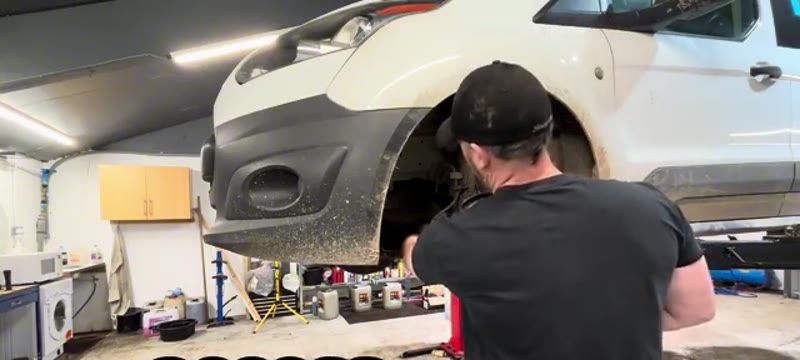
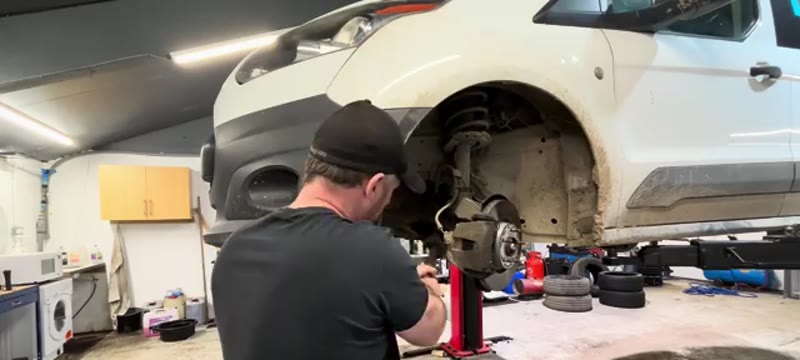
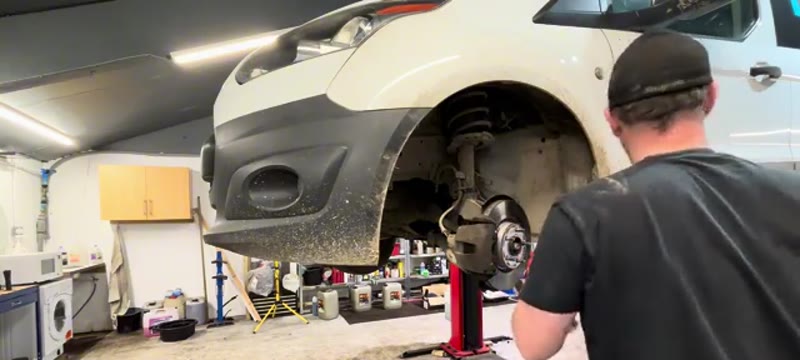
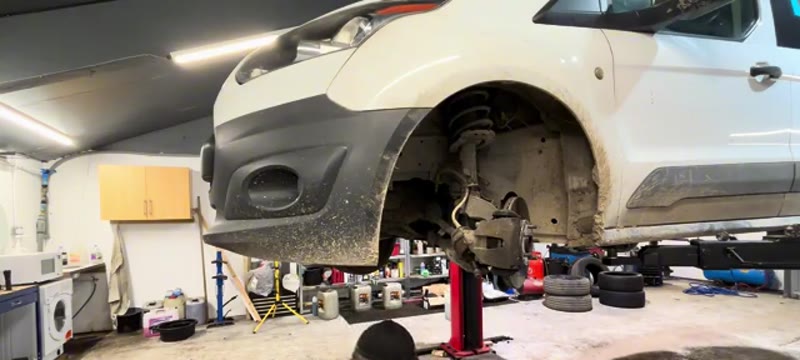
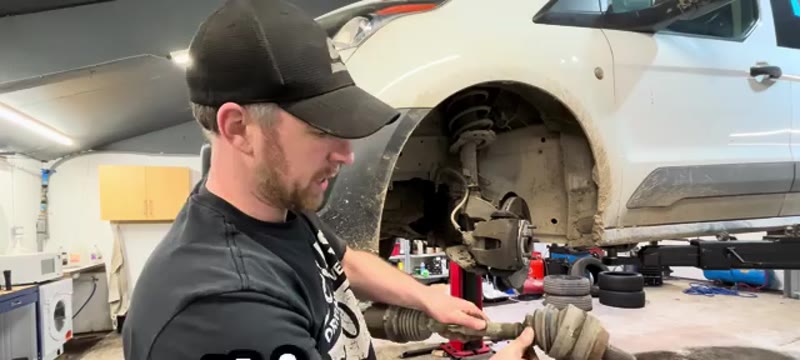
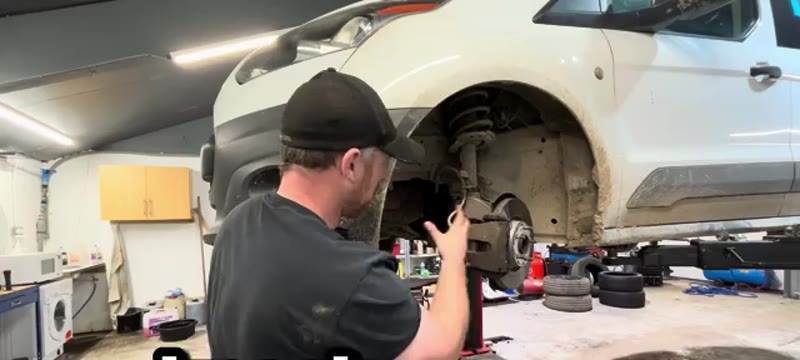
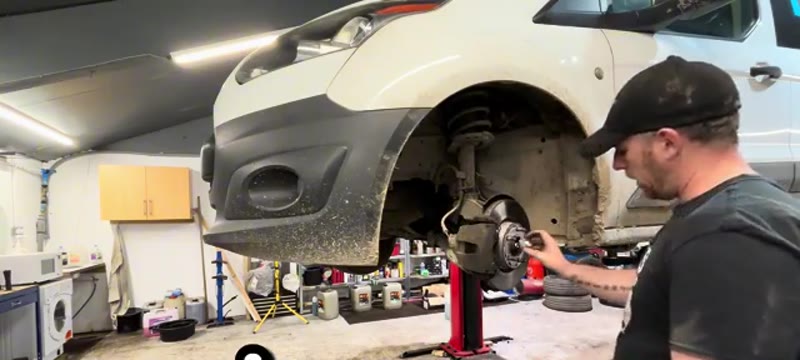
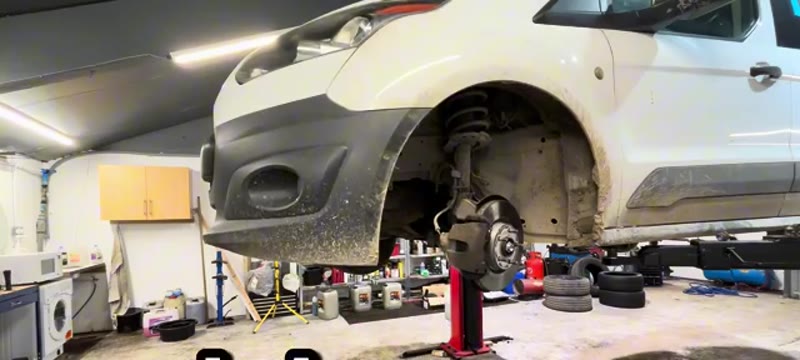
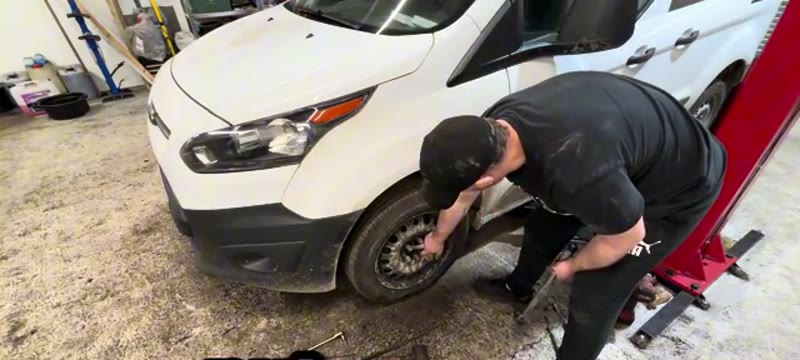
It is honest heavy spanner work - a hub nut at serious torque, a lever bar, a copper hammer. Not technical, but physical. A beginner with a breaker bar and confidence can do it; just buy the new hub nut before starting, not after.
Overview
A clicking or knocking noise on full lock on the Ford Transit Connect 2017 is almost always caused by a worn outer CV joint. The CV joint cannot be replaced separately on this vehicle - the entire driveshaft must be replaced as a unit.
This job requires the hub nut to be undone and the lower suspension arm to be disconnected to allow the hub to move out of the way. Gearbox oil will escape when the old shaft is removed so have a container ready.
When You Need This Job
Clicking or knocking noise on full steering lock
Noise gets worse when turning sharply at low speed
Split CV joint boot visible
Play in the outer CV joint when inspected
⚠ Have a container ready for gearbox oilWhen the driveshaft is removed from the gearbox a small amount of oil will run out. Catch it and measure the quantity so you can refill to the same level.
Tools You'll Need
T30 Torx (undertray bolts)
18mm socket (lower arm pinch bolt nut)
T55 Torx (lower arm pinch bolt)
32mm socket (hub nut)
Lever bar
Copper hammer
Torque wrench
Know your car inside out
The UK Car Owner's Essential Guide
Every dashboard warning light explained
Fluid, tyre and service checks you can do yourself
Instant PDF download · works on phone, tablet or PC · 7-day money-back guarantee
Step-by-Step Guide
01
Remove the wheel and undertray
Remove the front wheel. The undertray is held by T30 Torx bolts all around - undo them and slide it out. This gives full access underneath for levering the driveshaft out.
02
Remove the lower arm pinch bolt
Use an 18mm socket on the nut and a T55 Torx on the other side. The T55 holds the splined bolt still while you spin the 18mm nut off. Once the nut is removed use a copper hammer to knock the pinch bolt out. Knock the lower arm down to release it from the hub.
03
Remove the hub nut - 32mm socket
Undo the 32mm hub nut. Give the centre of the driveshaft a tap to ensure it is free to slide through the hub.
04
Lever the driveshaft out of the gearbox
Place a lever bar behind the driveshaft inner joint where it enters the gearbox. A sharp lever will pop the circlip and release it. Catch any gearbox oil in a container.
05
Inspect the old shaft
The fault will be in the outer CV joint - check for play and condition. A split or missing boot will have allowed grease out and dirt in, destroying the bearings.
06
Fit the new driveshaft - inner end first
Check the new shaft has a C-clip on the inner end - this is what holds it in the gearbox. Line up the splines and knock the inner end into the gearbox with a copper hammer until the tone changes confirming it is seated.
07
Refit the outer end into the hub
Slide the outer splined end through the hub. Fit the new hub nut finger tight to keep it in position.
08
Refit the lower arm
Pull the lower arm down and align it with the hole in the hub. Tap it back in with a copper hammer. Refit the pinch bolt - T55 Torx to hold it, 18mm nut to tighten.
09
Torque the hub nut
Torque the hub nut to 80 Nm plus 90 degrees. Refit the undertray and wheel. Torque wheel nuts. Check and top up gearbox oil level if needed.
Torque Specifications
Component
Torque
Hub nut
80 Nm + 90°
Lower arm pinch bolt nut (18mm)
70 Nm
Wheel nuts
135 Nm
Check gearbox oil after refitting
After fitting the new shaft check the gearbox oil level. Insert a piece of wire to the fill hole level - if it comes out wet the level is correct.
A driveshaft's CV joints live inside rubber boots full of grease, and the boots are the whole story: a split boot flings its grease out and lets grit and water in, and the joint grinds itself to death over the following months. On a Connect the boots split early and often - vans ride lower on their suspension travel when loaded, work full-lock turns in yards and side streets all day, and rack up miles at a rate that ages rubber fast. The soundtrack of the end: a rhythmic click on full-lock turns (outer joint), a clunk on drive take-up or a vibration under acceleration that fades on the overrun (inner joint). By the clicking stage, replacement is due - a CV joint that lets go completely leaves the van dead in the road with cargo aboard.
Garage vs DIY Cost
Who does it
Typical price
What you get
Ford Transit centre
£300–£500
Genuine shaft and dealer labour
Independent garage
£200–£350
Complete quality shaft fitted
DIY
£80–£150
A complete new shaft and 2-3 hours - no joint rebuilding required
Typical UK prices for the 2017 Connect. The complete-shaft approach is what makes this a DIY job: the old shaft comes out as a unit and the new one goes in the same way.
Complete Shaft vs Boot Kit vs Reconditioned
Caught early - boot split, no clicking yet - a £15 boot kit and fresh grease saves the joint, and checking boots at every service is how fleets avoid this whole page. Once the joint clicks, buy a complete new shaft: GKN (the OE joint maker), SKF and Lobro list them at £80–£150, joints and boots already assembled. Reconditioned shafts at £60–£90 are acceptable from a reputable rebuilder, but check the exchange terms. The £45 marketplace shaft uses joints of mystery steel - on a loaded van they hum from new and click within the year, and the labour repeats.
Common Mistakes on the Driveshaft Job
Reusing the hub nut. It is staked or stretch-torqued, single use, and it sets the wheel bearing preload. A reused nut works loose and takes the bearing with it.
Letting the inner joint hang by its boot. Support the shaft as it comes out - the inner tripod joint pulls apart under its own weight and the rollers drop into the gearbox oil or the gutter.
Tearing the gearbox oil seal on extraction. The inner end levers out of the differential past a lip seal. Pry squarely with the proper fork, and have a new seal on hand - a torn one weeps gear oil down the subframe for months.
Forgetting the gearbox oil level. Some oil follows the shaft out of the diff. Check and top the level before the van works again.
Hammering the new shaft into the hub splines. Clean the splines and it slides; hammering mushrooms the thread end, and the new hub nut will not torque true.
Related Driveline Faults on the Connect
Clicks and clunks have neighbours: a clunk on take-up can equally be engine mounts or a worn inner joint; vibration at speed that does not change with acceleration is wheel balance, not driveline; and a droning that rises with road speed is the wheel bearing behind the brakes rather than the shaft. While the wheel and shaft are off, check the bearing for play, the boot on the other end of the same shaft, and the gearbox mounts. The symptom finder tells click, clunk, hum and drone apart before parts money moves - on driveline noise it earns its keep.
Quick Stats
Difficulty
Advanced
Vehicle
Ford Transit Connect 2017
Time
2–3 hrs
Parts Cost
£80–£200
Common Questions
FAQ
It is a middle-difficulty job - doable at home with a decent socket set, a breaker bar for the hub nut and a lever bar to pop the inner joint out. The CV joint cannot be replaced separately on this van, so it is the complete driveshaft - which actually simplifies things: no joint rebuilding, just old shaft out, new shaft in.
£200–£350 at a garage. A complete new driveshaft is £80–£150, so the saving is real. Buy a quality shaft - budget shafts with soft CV joints are clicking again within the year.
Around two hours. The hub nut and freeing the inner joint are the wrestling matches; everything else is straightforward. Have a new hub nut to hand (they are single-use on most) and check the gearbox oil level afterwards, as some always follows the inner joint out.
The big-ticket item is a 32mm hub nut socket on a breaker bar or impact gun. Around it: T30 and T55 Torx bits, an 18mm socket for the pinch bolt, a lever bar, a copper hammer and a torque wrench for the rebuild.
Free from Mr Auto Fixer
Get my used car inspection checklist – free
The same checklist I use when a mate asks me to look over a car before they buy it. I will email you the printable PDF, plus new guides as I write them. No spam, unsubscribe any time.
Done – check your inbox, the checklist is on its way.
Something went wrong. Please try again in a moment.
20+ Years ExperienceMOT TesterProfessional UK Mechanic
All guides on this site are written from real, hands-on experience - not copy-pasted from a manual. If I haven't done the job myself, it doesn't go on the site.