What Is P0087?
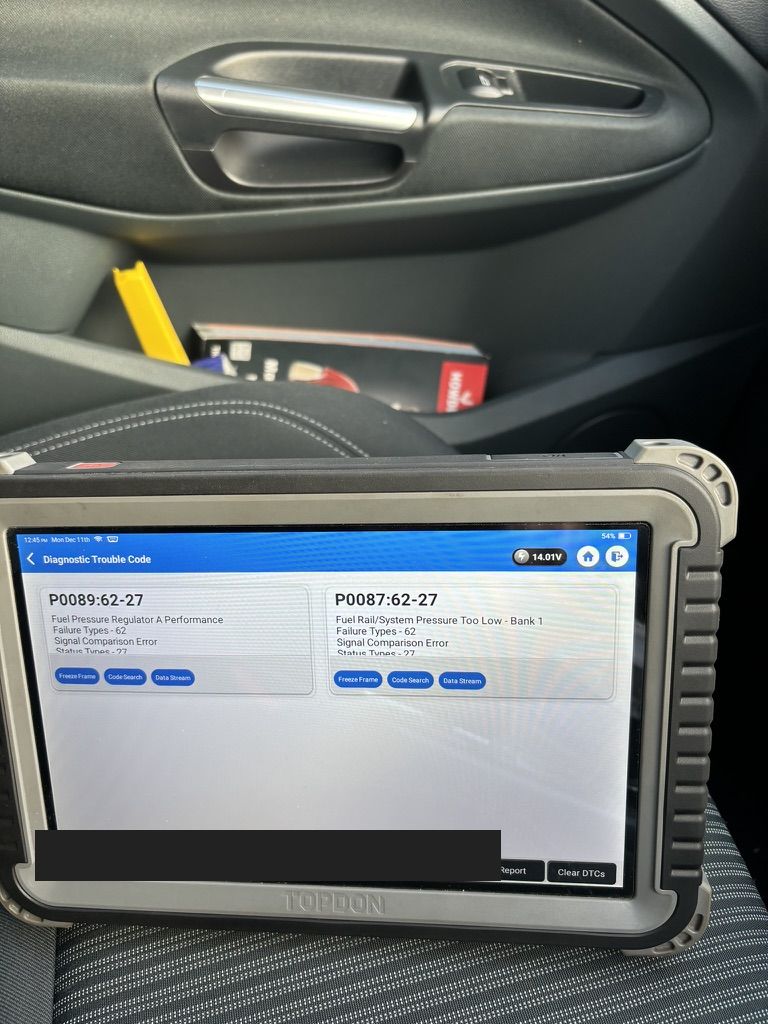
P0087 means the fuel rail pressure sensor is reporting pressure below the minimum threshold required for normal operation. The ECU compares actual rail pressure against the demanded target at all times - when measured pressure falls too far below target, P0087 is stored. This code affects both petrol direct injection (GDI) and diesel common rail engines, where precise fuel pressure is essential for correct injection timing and atomisation.
Low rail pressure causes lean running, hesitation, misfires, and in severe cases a no-start condition. On diesel engines it is particularly serious - inadequate rail pressure means injectors cannot deliver a precise fuel quantity, causing rough running, power loss, and potential injector wear from poor atomisation. Do not ignore P0087 on any engine.
Common Symptoms
- Engine management light on
- Hard starting or no-start
- Power loss under acceleration
- Engine hesitation or stumble under load
- Rough idle
- Misfires - P0300 may also be stored
Common Causes
How to Diagnose P0087
{intro}
Every P0087 outcome, written out in full
The tool above asks a couple of questions and lands you on one of these 5 results. They are all set out here as well, so you can read them without clicking through, compare them against each other, or check one on a phone with no signal.
If you answered Cuts to limp mode when I accelerate hard, then Longer ago than that, or I have no idea
Drive carefully, book it in Low rail pressure on a diesel with an unknown filter history has one answer far more often than all the others put together, and it is the cheapest one on the list. Do not let anyone sell you a pump before this has been done.
- Blocked fuel filter (Most likely) A filter choked with wax, water and debris passes enough fuel for idle and light throttle and starves the pump the moment you demand real flow. That is exactly the pattern of a car that limps only under acceleration. Around £20-£60 for the part and half an hour on most cars.
- Collapsing or porous suction hose (Likely) The low pressure hose between tank and pump goes soft with age and gets sucked shut under demand, or draws air through its own wall. Look for a hose that has gone spongy and for tiny bubbles in a clear filter housing while the engine is running.
- Blocked tank strainer or tired lift pump (Possible) The gauze sock on the pickup in the tank silts up, particularly on cars that live on a low tank. It gives the same starvation as a blocked filter and it is the next thing to check once a fresh filter has not fixed it.
What to do next: Change the filter, prime the system properly, then clear the code and drive it the way that used to trigger the fault. Two things matter when you do it: fill the new filter with clean diesel before fitting where the design allows it, and cut the old one open. What you find inside tells you whether you have solved it or whether something is shedding debris upstream.

OBD Fault Code Plain English Guide
- 100 most common UK fault codes in plain English
- A severity rating for every code so you know what can wait
- Causes and next steps listed for each fault
Instant PDF download · works on phone, tablet or PC · 7-day money-back guarantee
If you answered Cuts to limp mode when I accelerate hard, then Within the last two years or 25,000 miles
Drive carefully, book it in With a known good filter, low rail pressure becomes a real diagnostic job rather than a service item. The good news is that live data splits the remaining causes cleanly, so nobody should be guessing with your money from here.
- Injector back-leakage (Most likely) Worn injectors dump fuel back to the tank instead of holding rail pressure, and four slightly leaky injectors together will drag the rail down under load. A back-leakage test with measuring cylinders on the return pipes finds it and names the cylinder. Ask for that test by name.
- Suction control valve or pressure regulator (Likely) The valve that meters fuel into the high pressure pump wears and sticks, so the pump never reaches the pressure the ECU asks for. Common enough on Denso and Bosch systems to be worth checking early, and much cheaper than a pump at £80-£250.
- Worn high pressure pump (Possible) The genuine pump failure is the least likely and the most expensive, so it should be the last thing proven, never the first thing assumed. If the pump has failed internally on a Bosch CP4, the system must be checked for metal debris before anything new is fitted or the new parts die too.
What to do next: Get live data logged for requested rail pressure against actual rail pressure during the fault. If actual tracks requested until the moment of failure, look at supply and injectors. If actual never gets near requested even at idle, the metering valve and pump move up the list. That single graph is worth an hour of guessing.
If you answered Hard to start, worse when the engine is already warm
Drive carefully, book it in Hard starting that is worse hot, with P0087 stored, is the textbook injector back-leakage pattern. Hot fuel is thinner, worn injector clearances leak more, and the rail cannot build cranking pressure.
- Injectors leaking back (Most likely) When the engine is hot the fuel is thin and the worn clearances inside a tired injector let rail pressure bleed away to the return line faster than the pump can build it while cranking. Classic on high mileage HDi, TDCi and CDTi engines. Prove it with a back-leakage test before replacing anything.
- Leaking pressure regulator or rail sensor seal (Likely) The regulator on the rail can seep internally and give the same slow bleed-down as leaky injectors, for a fraction of the cost. Worth checking first purely because it is cheap to rule out.
- Air drawn in on the low pressure side (Possible) A weeping filter housing seal or a cracked union lets the fuel drain back to the tank while the car sits, so the first crank is spent refilling the system rather than building pressure. Look for a filter housing that is dry when hot and damp when cold.
What to do next: Try this test yourself before booking anything: when it is being difficult, turn the key to ignition on and off three or four times without cranking, then crank. If it fires much more readily, you are watching the lift pump refill a system that has bled down, which strongly supports leak-back rather than a worn pump.
If you answered Loses power at motorway speed, comes back after a stop
Drive carefully, book it in Losing pressure only at sustained motorway speed and recovering after a stop is a heat and flow pattern. The system copes with short bursts of demand and runs out on a long steady one.
- Restricted supply that only shows at sustained high flow (Most likely) A partially blocked filter or a silted tank strainer keeps up with town driving and falls behind after ten minutes at 70mph. The recovery after a stop is the giveaway - the tank pressure equalises and the restriction lets fuel through again.
- Fuel getting hot and returning hot (Likely) On some diesels a blocked return line or a failed fuel cooler sends progressively hotter fuel back around. Hot fuel is less dense, the pump works harder for the same pressure and the rail drops off target. Usually accompanied by a fault that only ever appears on long runs.
- Marginal high pressure pump (Possible) A worn pump that still makes rated pressure in short bursts cannot hold it for thirty minutes. This is the answer of last resort and only after supply and returns have been checked properly.
What to do next: Log a long motorway run with a scanner recording rail pressure, requested pressure and fuel temperature if the vehicle offers it. A fault that only appears after twenty minutes will never be found on a driveway, and a recorded run saves you paying a garage to try to recreate it.
If you answered It happened suddenly after I ran the tank very low
Drive carefully, book it in Running a diesel tank right down is a genuine mechanical event, not just an inconvenience. The rubbish that lives at the bottom of a fuel tank gets drawn into a system that is built to very fine clearances.
- Debris pulled into the filter and strainer (Most likely) Years of sediment sit below the normal pickup level. Run the tank low once and it all goes through the strainer and into the filter at once. The pressure loss can appear within a single tank of driving afterwards.
- Air drawn into the system (Likely) Once the pickup uncovers, air enters the low pressure side and some systems never fully purge it without proper priming. The symptom is rough running and low rail pressure that comes and goes rather than a steady fault.
- Lift pump damaged by running dry (Possible) The in-tank pump is cooled and lubricated by the fuel around it. Run it dry and it can be left permanently weakened even after the tank is filled again, giving low supply pressure to the high pressure pump from then on.
What to do next: Change the fuel filter now regardless of its age, and cut the old one open to see what came through. If it is full of grit you have your answer and you should consider having the tank strainer inspected too. Then make a rule of never taking it below a quarter of a tank, which is genuinely cheaper than the alternative.
Check Companion Codes
P0087 often accompanies P0171 (lean Bank 1), P0300 (misfire), or injector codes. Multiple companion codes confirm fuel pressure is genuinely low rather than a sensor fault.
Monitor Rail Pressure in Live Data
Connect an OBD scanner and read actual vs demanded rail pressure. On petrol GDI, idle pressure is typically 50–100 bar, rising to 150–200 bar under load. On diesel, 300 bar idle up to 1800 bar at full throttle. A large gap between demanded and actual confirms the fault.
Replace the Fuel Filter
If the filter is overdue for replacement, do this first. It is the cheapest potential fix (£20–£40) and eliminates restriction as a cause. On diesel engines check the fuel/water separator bowl for water contamination.
Test Low-Pressure Pump Output
Connect a mechanical pressure gauge to the fuel rail or a Schrader valve in the fuel line. Measure static pressure and pressure under snap throttle. Compare against the manufacturer specification for your engine.
Inspect High-Pressure Pump (Diesel)
On diesel common rail, monitor rail pressure at full-load acceleration. A significant pressure drop under demand points to high-pressure pump wear. HP pump replacement is a major job - confirm this is the cause before committing.
Mechanic's Corner - P0087 on UK Cars
On UK diesel vehicles - particularly VAG Group (VW, Audi, Skoda, SEAT) 2.0 TDI engines - P0087 is frequently caused by a failing high-pressure fuel pump (HPFP) rather than a low-pressure supply issue. The VAG 2.0 TDI HPFP is known to shed cam follower material into the fuel system, which then damages the injectors. If a 2.0 TDI is presenting P0087 alongside rough running or hard starting, check the cam follower on the HPFP first - it's a 20-minute job and the follower is a £10 part. Catching it early avoids a £1,200+ HPFP replacement.
On Ford diesel engines (1.5 TDCi, 2.0 TDCi), a split low-pressure fuel supply hose between the tank and high-pressure pump is a common cause of P0087. The hose becomes porous with age and allows air ingestion that starves the system of fuel under load. The symptom is power loss that clears when the engine is switched off and restarted - a characteristic air-in-fuel response.
Verdict
Replace the fuel filter first if overdue - this £20–£40 fix resolves many P0087 cases. If rail pressure remains low after filter replacement, fuel pump testing is next. HP diesel pump replacement is expensive (£400–£1,000+), so confirm pressure deficiency with live data before replacing.